
FUENTE http://www.metmuseum.org/toah/works-of-art/26.72.68
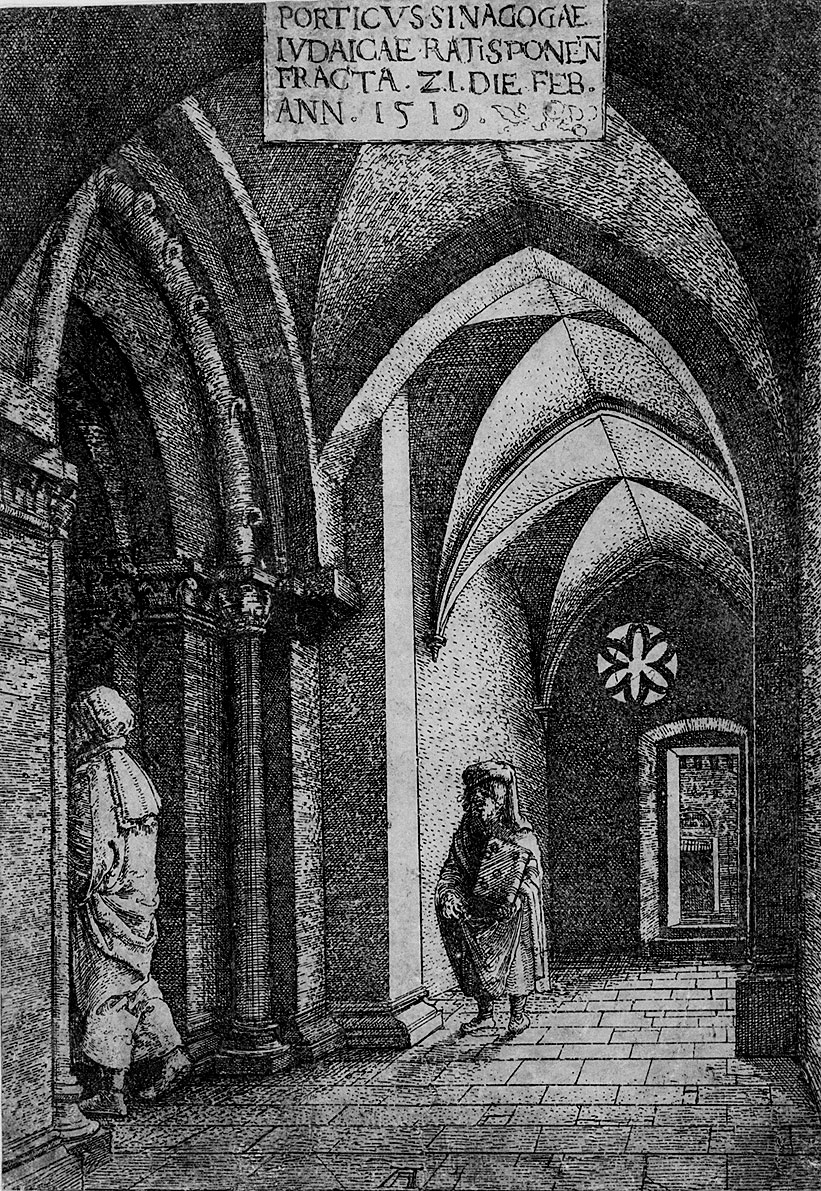
The Entrance Hall of the Regensburg Synagogue, 1519
Albrecht Altdorfer (German, ca. 1480–1538)
Depicted: Regensburg, Germany
Etching
6 1/4 x 4 3/8 in. (15.9 x 11.1 cm)
Harris Brisbane Dick Fund, 1926 (26.72.68)
NOT ON VIEW Last Updated July 3, 2012
In the muted light of an open doorway and a rosette window, two Jewish men are shown walking through the entry porch of the Regensburg synagogue. Altdorfer made two etchings of the temple just before it was destroyed on February 22, 1519: this view and one of the interior nave. Emperor Maximilian had long been a protector of the Jews in the imperial cities, extracting from them substantial taxes in exchange. Within weeks of his death, however, the city of Regensburg, which blamed its economic troubles on its prosperous Jewish community, expelled the Jews. Altdorfer, a member of the Outer Council, was one of those chosen to inform the Jews that they had two hours to empty out the synagogue and five days to leave the city. The date of the demolition inscribed at the top of the print suggests that Altdorfer made the preparatory sketches, as well as the etchings themselves, with the knowledge that the building was to be destroyed. The prints appear to have been quickly produced, quite possibly during the five days prior to the temple's destruction: the plate was not evenly etched, particularly in the areas of dense hatching, where the individual lines lose clarity. In addition, the slightly tipsy vaults appear to have been traced freehand rather than with a compass. Despite the seemingly sensitive portrayal, the print was not intended as a sympathetic rendering of an aspect of Jewish culture, but rather as a much more dispassionate recording of the site. It is thus the first portrait of an actual architectural monument in European printmaking.
ANALISIS DE LA IMAGEN
Surviving works of art provide inadequate testament to the importance of the Jewish community of Europe in the Middle Ages. While always a minority population, and despite recurring, intense persecution and exile, Jews throughout Europe made key contributions to the intellectual life, art, science, and commerce of medieval and Renaissance Europe. Jews served as both patrons and artists, and the art that does survive reveals awareness by Jews of the artistic currents of the day and regular interaction with the majority Christian or Muslim (in the case of Spain) community.
Jews served as both patrons and artists, and the art that does survive reveals awareness by Jews of the artistic currents of the day and regular interaction with the majority Christian or Muslim (in the case of Spain) community.
Related
Cited Works of Art or Images (6)
Timelines (4)
Primary Thematic Essays (2)
Other Thematic Essays (28)
Maps (3)
Index Terms (54)
Share
After the Romans' destruction of the Second Temple in Jerusalem in the year 70, the practice of Judaism shifted from a focus on sacrifice to the study of sacred texts, the celebration of holy days, and the religious observance of the life cycle, all of which provided opportunities for the production and patronage of art. Torah scrolls were undecorated, but other Hebrew texts were painted with narrative and decorative imagery. Haggadot, books containing the text of the Passover Seder, sometimes depict scenes from the Bible or images of the contemporary celebrations of the Seder. Examples from medieval Spain are especially fine. (Jewish communities of the Iberian Peninsula have a particularly rich artistic and intellectual heritage owing to long periods of religious tolerance by both Muslims and Christians prior to the persecution of 1391 and eventually forced expulsion of the Jews in 1492 from Spain and 1497 from Portugal.) Works by Jewish scholars, such as the biblical commentator Rashi or the philosopher Maimonides, were also sometimes illustrated, as were books of science and law. Prayer books for individuals might be painted by artists who also worked for Christian clients. The Florentine artist Mariano del Buono, for instance, was responsible for both a woman's mahzor, or prayer book, and a Christian choir book (96.32.15). Book decoration could also take the form of inventively rendered Hebrew script, such as Arabic-looking Hebrew texts.
Though a number of ritual objects, such as Hanukkah lamps and kiddush cups, were prescribed for the proper observation of Jewish ceremonies, Jewish law gave only minimal instruction as to their form. Consequently, Jews often employed objects for religious rituals that might otherwise find a place in a Christian home, and recognizable, distinctive Jewish ceremonial objects evolved only gradually. For example, we know from manuscript illuminations that a secular drinking cup of glass or silver might be used as a kiddush cup, for blessing wine on Sabbaths and holy days. (06.141). Wealthy Jews embraced the same luxury items favored by their Christian neighbors: manuscript illustrations, coats of arms, or Hebrew inscriptions indicate that items such as ceremonial double cups (17.190.609a,b) and aquamanilia might sit in a Jewish cupboard.
Medieval synagogue architecture frequently adopted the form and decoration of contemporary Christian building. The synagogue at Regensburg, for example, built between 1210 and 1227, featured pointed arches, carved capitals and a rose window, as in a Gothic church (26.72.68). The thirteenth-century synagogue that survives at Prague similarly includes Gothic elements, including a non-figural, carved tympanum over the door.
Medieval Christian objects often attest to an intense dialogue with Jewish scholars. Because Christian faith developed out of Judaism, Christian theologians, beginning with Saint Jerome, were often intent on learning Hebrew. Others were eager to challenge Jewish belief, or were threatened by the Jews' lack of interest in converting. Persecutions linked to the First Crusade in 1096, the Black Death, and later the Inquisitions, offer notorious examples of Christian intolerance and cruelty towards the Jews, and works of art can echo the sound of contemporary prejudice (63.12). Yet other works suggest a more nuanced Christian attitude about the heritage of Judaism. Among the most imposing are objects such as the massive bronze menorah in the Cathedral of Essen on the Rhine, where there was a thriving Jewish community, or the head of King David from Notre-Dame in Paris (38.180), where the University established a chair in Hebrew. The column figure of a prophet from Saint-Denis near Paris (20.157) is one of a series that, by the figures' placement at the entrance of the church, literally and figuratively provided the support necessary to sustain the church as the perceived rightful successor to the synagogue. Coincidentally, the figure comes from a monastery whose abbot was directly responsible for the Jews of the town. Stained glass in the church bears inscriptions proclaiming the relationship between God's covenant with Israel and Christian belief in a new covenant. Images of Jews and Jewish ceremony are often portrayed with remarkable accuracy. Some Spanish altarpieces, as recent scholarship has shown, portray the interiors of medieval synagogues and present biblical Jews in medieval costume (25.120.929; 32.100.123). These reflect Christian awareness of Jewish practice, and consultation with, or even the use of Jewish artists, to which surviving documentary evidence attests.
Barbara Drake Boehm
Department of Medieval Art and The Cloisters, The Metropolitan Museum of Art
Melanie Holcomb
Department of Medieval Art and The Cloisters, The Metropolitan Museum of Art
Produced in cooperation with the Library of the Jewish Theological Seminary, New York
Citation
Boehm, Barbara Drake, and Melanie Holcomb. "Jews and the Arts in Medieval Europe". In Heilbrunn Timeline of Art History. New York: The Metropolitan Museum of Art, 2000–. http://www.metmuseum.org/toah/hd/jewm/hd_jewm.htm (originally published June 2008, last revised August 2010)
Further Reading
Haverkamp, Alfred. The Jews of Europe in the Middle Ages. Ostfildern: Hatje Cantz, 2004.
Mann, Vivian B., ed. Gardens and Ghettos: The Art of Jewish Life in Italy. Berkeley: University of California Press, 1989.
Mann, Vivian B., ed. Uneasy Communion: Jews, Christians, and the Altarpieces of Medieval Spain. Exhibition catalogue. New York: Museum of Biblical Art, 2010.
Mann, Vivian B., et al., eds. Convivencia: Jews, Muslims, and Christians in Medieval Spain. New York: G. Braziller, 1992.
Mintz, Sharon Liberman, et al. Precious Possessions: Treasures from the Library of the Jewish Theological Seminary. New York: Jewish Theological Seminary of America, 2001.
Suggested Online Resources
Jewish Theological Seminary Library
The New York Public Library: An Introduction to Hebrew Manuscripts

No hay comentarios:
Publicar un comentario